Does Your Business Really Need a Podcast?
There is already too much content.
LinkedIn is full of it. Your inbox is full of it. AI has made it possible for almost any business to produce articles, social posts, emails, graphics and campaigns at extraordinary speed.
So why would you want to add a podcast to the pile?
Because a good business podcast isn't really about producing more content.
It's about producing something worth paying attention to.
Your business already has something to talk about
One of the biggest misconceptions about podcasting is that you need to become a media company, find a celebrity host or spend every week dreaming up fascinating subjects.
You don't.
Some of the most useful conversations are probably already happening inside your business.
Your product team is talking about what you're building next. Sales is hearing questions and objections from customers. Marketing is trying to work out which messages resonate. Your leadership team has a view on where the market is heading.
Your customers have questions.
Your people have answers.
Put the right people around a microphone and suddenly you have something interesting.
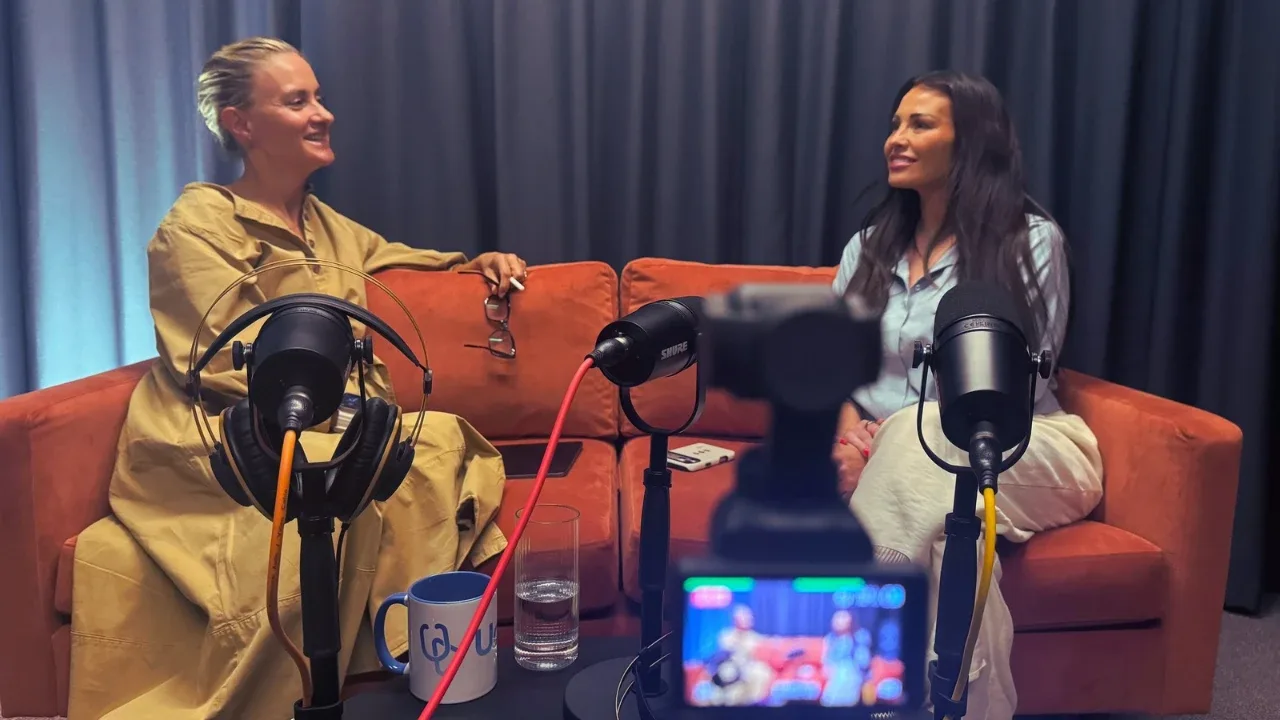
Podcasting gives people access to the people behind your business
Businesses spend enormous amounts of time trying to sound authentic.
A podcast gives you the opportunity to actually be authentic.
Long-form conversation is difficult to fake. People explain things differently when they're talking rather than writing marketing copy. They go off-script. They tell stories. They disagree. They explain why decisions were made.
Most importantly, customers begin to get to know the people behind the logo.
And people still buy from people.
As AI makes competent marketing content increasingly easy to produce, genuine expertise and human conversation become useful ways for brands to distinguish themselves.
One conversation can become an entire marketing campaign
This is where podcasting becomes particularly interesting from a marketing perspective.
Imagine recording a 45-minute conversation between your CEO, product lead and someone from your commercial team.
You publish the full conversation as a video podcast on YouTube and Spotify, with the audio distributed through Apple Podcasts and other podcast platforms.
But that's only the beginning.
That single recording might also produce:
- 8–12 short video clips for LinkedIn and other social channels
- an SEO-focused article based on the transcript
- several shorter articles answering specific customer questions
- quotes and graphics for social media
- material for your email campaigns
- sales enablement content
- website FAQs
- thought-leadership posts
- clips for paid campaigns
- content for customer nurture programmes.
Instead of constantly asking "What should we post this week?", you've created a source of original material that can feed your marketing for weeks.
That's why we think about podcasts as marketing engines rather than isolated pieces of content.
It can make your product marketing better too
Here's a simple example.
Imagine you're a software company.
Customers are asking for a particular feature and some are starting to investigate competing products.
Your product team knows the feature is coming, but customers don't.
Now imagine your product lead sits down with your CEO and explains what's coming over the next six months.
They discuss the roadmap, the problems they're solving and why particular features are being prioritised.
For an existing customer, that's valuable content.
For a prospect comparing you with a competitor, it could be even more valuable.
Each significant feature discussed can then become its own clip, article, email or campaign.
Suddenly the product roadmap isn't just an internal document.
It's a marketing and sales asset.
B2B podcasts don't need enormous audiences
This is particularly important.
A B2B podcast doesn't necessarily need 100,000 listeners.
It needs the right listeners.
If 300 people listen to an episode and 50 of them are people who influence purchasing decisions in your target market, that could be considerably more valuable than thousands of casual social impressions.
That changes how you should measure success.
Downloads matter, but so do watch time, completion rates, engagement, website visits, enquiries, conversions and the performance of the content created from each recording.
At MBMS Podcast Studio, our background in senior-level marketing means we approach podcasting through brand, creative and performance marketing, not simply production.
We look at what you're trying to achieve commercially, who needs to hear the conversation and how the resulting content can work across your wider marketing activity.
Audio and video both matter
A modern podcast doesn't have to mean somebody sitting behind a microphone in a dark studio.
It might be a traditional audio podcast.
It might be a multi-camera studio conversation.
It could be recorded remotely.
It could even be a conversation recorded while walking around your business, factory, event or workplace.
The format should fit the conversation.
Video gives you an additional advantage because it creates material for YouTube, Spotify and social channels, while the audio can be distributed through Apple Podcasts and other listening platforms.
One recording can therefore work across multiple channels without creating entirely separate campaigns for each one.
There's an SEO benefit too
Every podcast contains words.
Lots of them.
Once a conversation is transcribed, those words become valuable raw material.
A discussion about five common problems faced by your customers could become five individual search-focused articles. A technical discussion could become an FAQ. A product conversation could become a landing page.
The podcast creates the original thinking.
Your marketing process turns that thinking into useful, searchable content.
And increasingly, that content isn't only being discovered through traditional search engines. Clear answers to real customer questions can also help businesses build a body of authoritative content that can be surfaced through AI-driven search and discovery.
Podcasting can even improve communication inside the business
There's another benefit that isn't discussed enough.
Knowing that you're going to talk publicly about something forces clarity.
If your product lead, sales director and marketing team are going to sit down next Thursday and discuss the product roadmap, everyone needs to agree what can actually be said.
- Is the feature definitely coming?
- When?
- Who is it for?
- What problem does it solve?
- Why should customers care?
Preparing for the conversation can expose gaps between departments before those gaps become customer problems.
In that sense, podcasting can become an internal alignment exercise as well as an external marketing channel.
So, should your business have a podcast?
Not necessarily.
Starting a podcast simply because everybody else seems to have one isn't much of a strategy.
But if your business has expertise, customers with questions, products worth explaining, interesting people, a developing market or a point of view worth sharing, you probably have the raw ingredients.
The question isn't really:
“Should we start a podcast?”
It's:
“What conversations should our business be having, and who would benefit from hearing them?”
That's where we start.
Talk to MBMS Podcast Studio
MBMS Podcast Studio helps businesses turn conversations into useful, measurable marketing.
We can support the entire process, from developing the initial idea and format through audio and video recording, editing and production to distribution across YouTube, Spotify and Apple Podcasts.
Then we help turn each recording into clips, articles, social content and campaigns, using brand, creative and performance marketing expertise to make the podcast work harder for the business.
You don't need to arrive with a finished podcast concept.
Sometimes you just need the first conversation.
Talk to MBMS Podcast Studio about what your business could be talking about